
About the Hidalgo County Clerk
The County Clerk is an elected official, and in Hidalgo County the office is held by Arturo Guajardo Jr. The office of County Clerk has existed in Texas since 1836, and the Hidalgo County page stresses that the clerk preserves, restores, and protects county history while pushing for modern, accessible service. That blend of old and new shows in the work: the clerk safeguards century-old paper records and also offers online land-record access for searching, viewing, printing, and downloading.
This office is not the District Clerk. The County Clerk serves the County Court, the County Courts at Law, and the Commissioners Court, and it records real and personal property along with vital records. The card below gives the contact details for the Hidalgo County Clerk.
Hidalgo County Clerk
Clerk: Arturo Guajardo Jr.
100 N. Closner
Edinburg, TX 78539
(956) 318-2100
Mon-Fri 8:00 a.m. to 5:00 p.m.
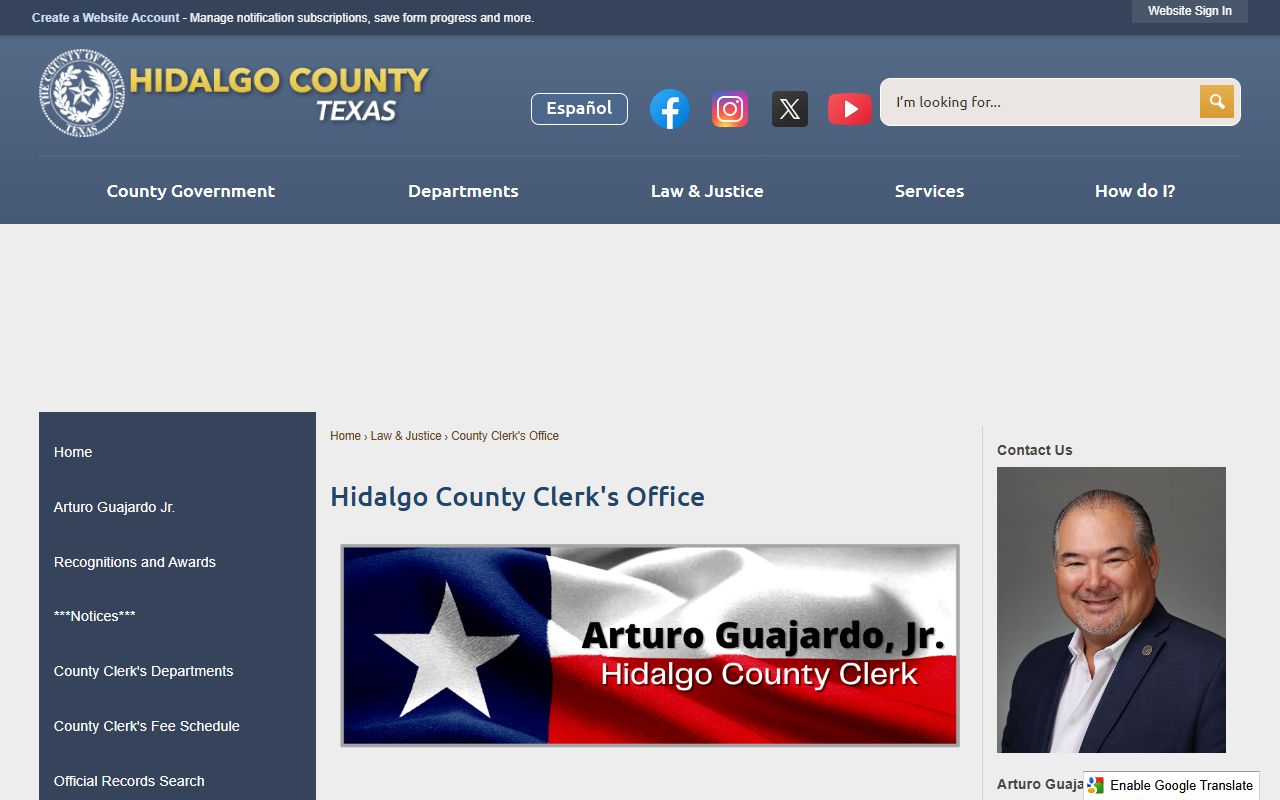
The County Clerk page is shown below.
What the County Clerk Does in Hidalgo County
The County Clerk wears several hats at once, which is why its records are so varied. It clerks for the county-level courts, records the documents that prove who owns land, files business names, and issues the vital records people need for everyday life. The duties below capture the main lines of work.
- Clerks the County Court, County Courts at Law, and Commissioners Court.
- Records deeds, liens, and other real property documents.
- Files assumed names, plats, and foreclosure notices.
- Issues marriage licenses and keeps marriage records.
- Holds birth and death records and DD-214 veteran discharges.
Because the office handles county court files, misdemeanor and county civil records run through the County Clerk rather than the District Clerk.
The County Clerk Official Records Search
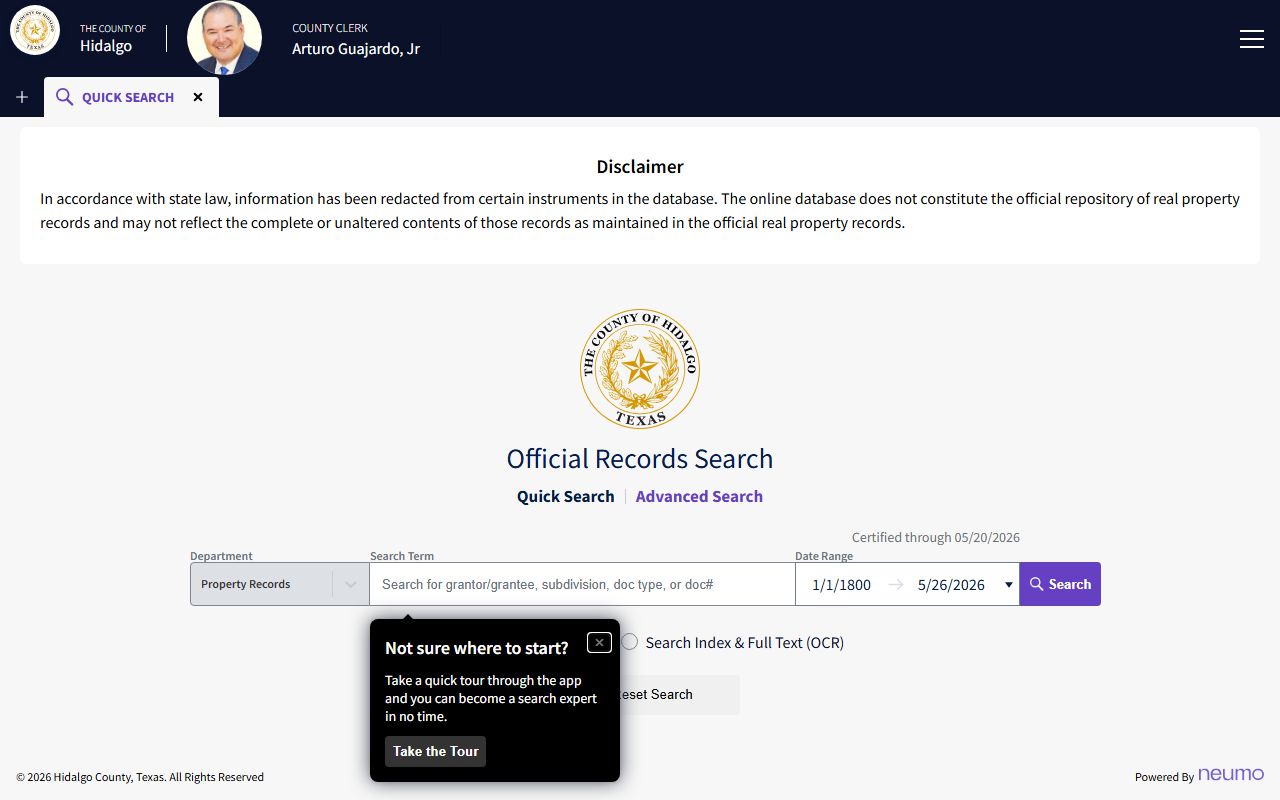
The County Clerk runs an online official records search for property and recorded documents. It lets you look up records by grantor or grantee name, subdivision, document type, or document number, and filter by a recorded-date range. You can search the index only or search the index and the full text using optical character recognition. The steps are simple, but the fields reward a careful search.
The County Clerk official records search is shown below.
| Field Label | Type | Notes / Format |
|---|---|---|
| Department | Filter | Property Records is the default scope. |
| Search Term | Text | Grantor, grantee, subdivision, document type, or number. |
| Date Range | Date | Start and end recorded-date range. |
| Search Scope | Toggle | Index only, or index and full text by OCR. |
| Image | Filter | Limits to records with a document image. |
Hidalgo County Clerk Fees
The County Clerk fee schedule covers recording, copies, searches, and vital records. A recent update under Senate Bill 1612 lowered the standard first-page recording fee and removed a $1 document filing fee from several record types. The table below lists common County Clerk fees.
| Item | Amount |
|---|---|
| Real estate filing, first page | $35.00 |
| Each additional real estate page | $4.00 |
| Official records search fee | $5.00 |
| Certification | $5.00 |
| Copies per page | $1.00 |
| Marriage license | $81.00 |
| Marriage license certified copy | $16.00 |
The same schedule lists assumed-name, plat, lien, and cattle-brand fees, and notes that a DD-214 veteran discharge is filed at no charge.
How to Request a Certified Copy
A certified copy from the County Clerk carries the office seal and is what banks, title companies, and agencies accept. The portal printout is informal. To order an official copy of a deed, a marriage record, or a county court document, you give the clerk enough detail to find the record and pay the fee. The steps below outline the process.
- Identify the record by document number, party name, or case number.
- Confirm whether you need a plain copy or a certified copy with the seal.
- Submit the request to the County Clerk with the fee.
- Pay the per-page copy fee plus the certification fee where it applies.
- Pick up or receive the certified copy from the office.
For court case files held by the other office, see the District Clerk page.
Marriage Licenses and Vital Records
The County Clerk's vital records work touches some of life's biggest moments. The office issues marriage licenses, records the executed license after the ceremony, and sells certified copies later. It also holds birth and death records and handles DD-214 veteran discharges and cattle brands. A marriage license has a 72-hour waiting period and expires 90 days after issuance, and blood tests are not required.
Because these records support name changes, benefits, and immigration steps, people often need a certified copy long after the event. A certified marriage license copy is $16, with extra copies at $6 each. For the full marriage process, fees, and accepted identification, see the marriage and divorce records page.
County Clerk vs District Clerk
The single most useful thing to know about Hidalgo County records is which clerk holds what. The County Clerk and the District Clerk are different offices with different files. Aiming a request at the wrong one only slows you down. The chart below sorts the two.
| Records | County Clerk | District Clerk |
|---|---|---|
| Misdemeanor and county court cases | Yes | No |
| Deeds, liens, and land records | Yes | No |
| Marriage and vital records | Yes | No |
| Felony, large civil, and divorce cases | No | Yes |
For felony, large civil, and family district cases, see the District Clerk page.
Real Property and Business Filings
Land and business records are a core part of the County Clerk's job, and the county ties this work to its mission of preserving Hidalgo County history. The office records deeds, deeds of trust, releases, abstracts of judgment, federal and state tax liens, hospital liens, and notices of foreclosure. It also files assumed name certificates, often called DBAs, and subdivision plats. These records establish ownership, secure debts, and put the public on notice of claims against property.
Modern access has changed how people use these files. The county notes that its land records are available online for searching, viewing, printing, and downloading, so a title search that once meant a trip to the courthouse can often start from a computer. For records that fall under the open-records process rather than recorded documents, see the public records page, and for court files, the court records search.
Common Questions About the County Clerk
The County Clerk's broad role raises a predictable set of questions. The short answers below should point you in the right direction.
What records does the County Clerk keep?
The County Clerk keeps county court and county court at law files, real property records like deeds and liens, business filings such as assumed names, and vital records including marriage, birth, and death. It does not keep district court files, which belong to the District Clerk. For other county documents that fall under open records, see the public records page.
How do I search land or deed records?
Use the County Clerk official records search. You can look up records by grantor or grantee name, subdivision, document type, or document number, and filter by recorded date. The county notes its land records are available online for searching, viewing, printing, and downloading. The search field details are listed earlier on this page.
Does the County Clerk handle divorce records?
No. Divorce is a district court case, so the District Clerk keeps the file, not the County Clerk. The County Clerk does issue and record marriage licenses. For divorce records and certified decrees, see the District Clerk page, and for marriage, the marriage and divorce records page.
Recent Fee Changes at the County Clerk
Fees at the County Clerk are not fixed forever, and a recent state law trimmed them. Under Senate Bill 1612, the legislature repealed a $1 document filing fee that had been authorized for certain recordings. As a result, the standard first-page recording fee for official public records dropped from $36 to $35, and the $1 fee was removed from official records recordings, assumed names and DBAs, foreclosure notices, plats, and marriage licenses.
The change is small per document, but it adds up for heavy filers like title companies and lenders. It also shows why you should read the current fee schedule rather than rely on an old figure. The County Clerk posts the updated schedule online, and the office notes the change directly on its fee page. For the broader fee picture across both clerks, see the District Clerk page.