
Texas District Courts Explained
District courts are the workhorse trial courts of Texas. They have general jurisdiction, which means they can hear the widest range of serious cases, from felony crimes to high-value civil disputes. Each district court covers one or more counties, and a populous county like Hidalgo has many of them. The court is identified by a number, such as the 92nd or the 370th, and each is led by a single elected judge who serves a four-year term.
This level sits above the county and justice courts and below the appellate courts. Texas keeps two high courts at the top: the Supreme Court for civil and juvenile matters and the Court of Criminal Appeals for criminal matters. Between the trial courts and those high courts are the intermediate courts of appeals. Hidalgo County's district court rulings are reviewed by the Thirteenth Court of Appeals.
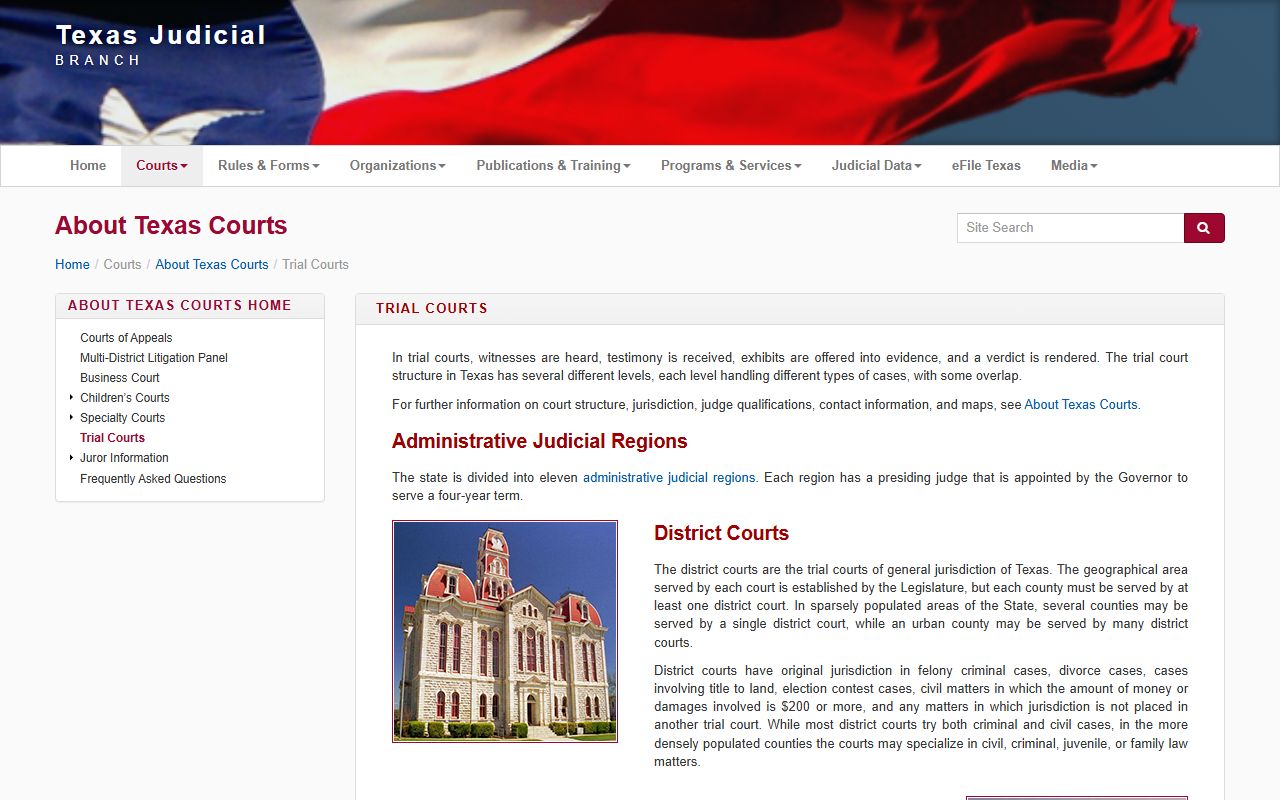
The Texas Judicial Branch explains how the trial courts fit together. The Texas trial courts overview is shown below.
Hidalgo County District Courts and Judges
Hidalgo County runs 13 numbered district courts, all based at the courthouse in Edinburg. The county lists each court with its presiding judge. The table below names every district court and the judge listed by the county. Most operate from the main courthouse at 100 N. Closner, and the 370th court publishes its own floor and direct line.
| Court | Judge | Location |
|---|---|---|
| 92nd District Court | Luis M. Singleterry | Hidalgo County Courthouse |
| 93rd District Court | Fernando Mancias | Hidalgo County Courthouse |
| 139th District Court | Roberto "Bobby" Flores | Hidalgo County Courthouse |
| 206th District Court | Rose Guerra Reyna | Hidalgo County Courthouse |
| 275th District Court | Marla Cuellar | Hidalgo County Courthouse |
| 332nd District Court | Juan R. Alvarez | Hidalgo County Courthouse |
| 370th District Court | Noe Gonzalez | 100 N. Closner, 2nd Fl.; (956) 318-2280 |
| 389th District Court | Letty Lopez | Hidalgo County Courthouse |
| 398th District Court | Keno Vasquez | Hidalgo County Courthouse |
| 430th District Court | Orlando J. Esquivel | Hidalgo County Courthouse |
| 449th District Court | Renee R. Betancourt | Hidalgo County Courthouse |
| 464th District Court | Joe Ramirez | Hidalgo County Courthouse |
| 476th District Court | Nereida Lopez-Singleterry | Hidalgo County Courthouse |
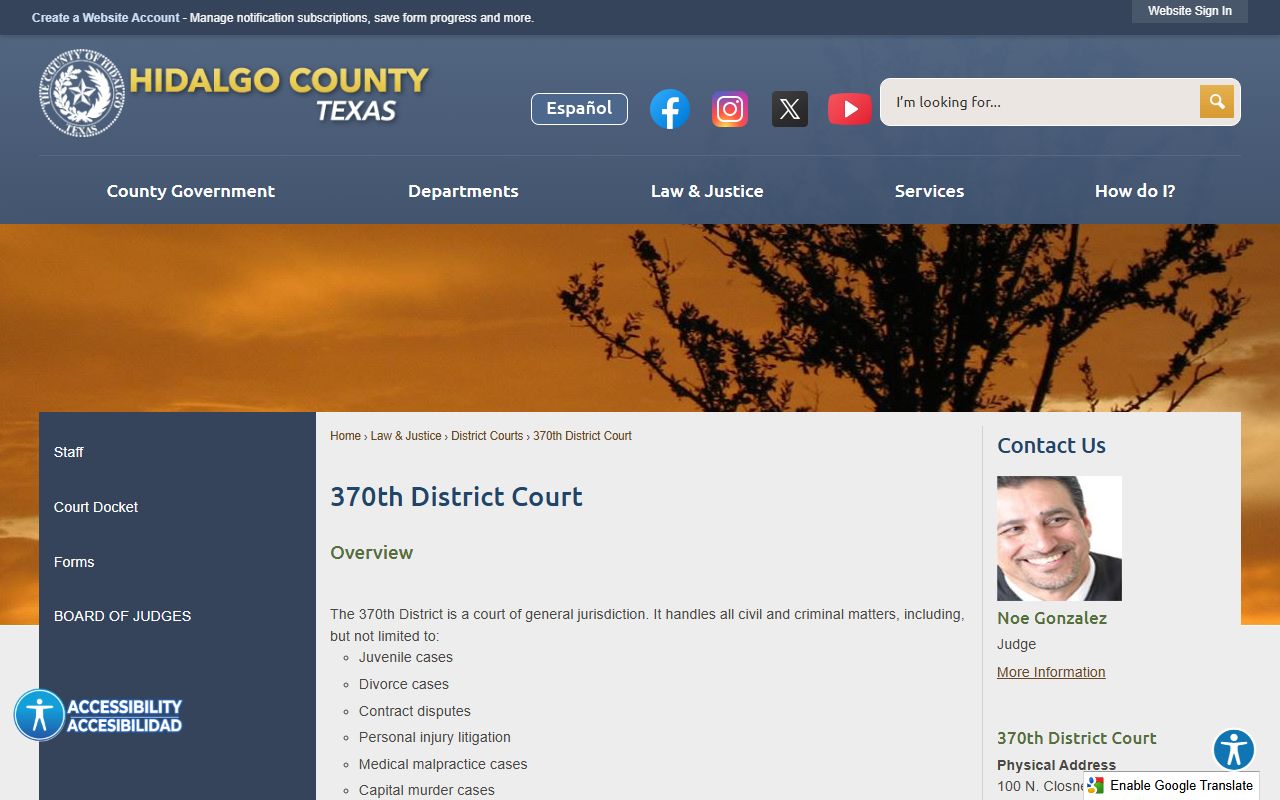
The county keeps the current judge list online. The 370th District Court page is shown below.
Hidalgo County District Court Jurisdiction
District courts handle the most serious matters in the county. On the criminal side, that means felonies, from theft and burglary up to aggravated robbery, sexual assault, intoxication manslaughter, and capital murder. On the civil side, they take larger disputes such as contract claims, personal injury, and medical malpractice. They also hear family cases like divorce and custody, and juvenile matters that fall under district jurisdiction.
The 370th District Court is a good example of the range. The county describes it as handling civil and criminal matters, including juvenile cases, divorces, contract disputes, personal injury and medical malpractice litigation, and serious crimes. That breadth is typical of a Texas district court, where one judge may move from a family docket to a felony trial in the same week. For the criminal side specifically, see the arrest records page.
County Courts at Law in Hidalgo County
Below the district courts sit the county courts at law. Texas created these statutory courts to take pressure off the constitutional county judge, and in Hidalgo County they hear misdemeanors, civil matters, family cases, and appeals from lower courts, depending on the court. They are clerked by the County Clerk rather than the District Clerk, which is a key difference when you search for a record.
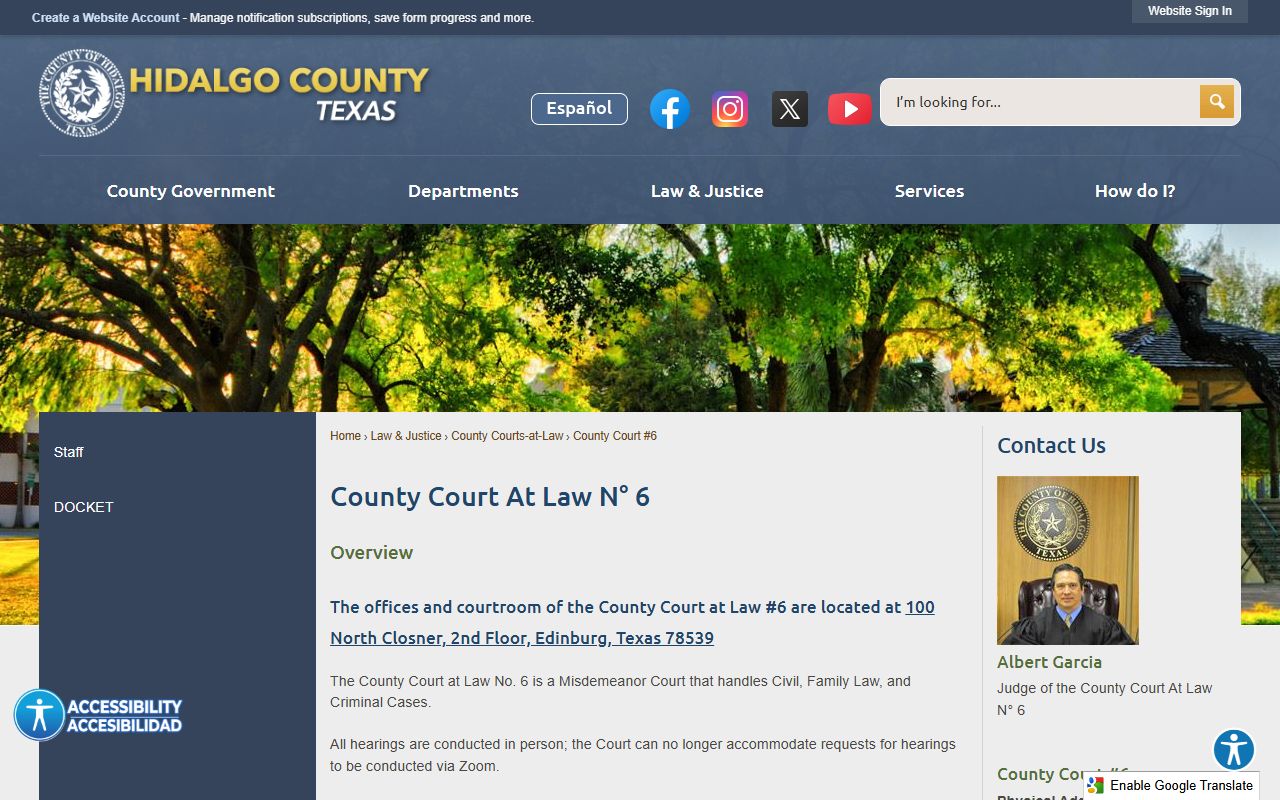
The county lists several county courts at law, and a few publish their own addresses and phones. County Court at Law #1 sits on the third floor of the courthouse, and County Court at Law #6 sits on the second floor. The County Court at Law #6 page is shown below.
| Court | Location | Phone |
|---|---|---|
| County Court at Law #1 | 100 N. Closner, 3rd Floor | (956) 318-2375 |
| County Court at Law #5 | 100 N. Closner Blvd., 2nd Floor | (956) 318-2460 |
| County Court at Law #6 | 100 N. Closner Blvd., 2nd Floor | (956) 289-7400 |
| Probate Court | 100 N. Closner, 3rd Floor | (956) 318-2385 |
District Court vs County Court vs Justice Court
Texas trial courts overlap, and the differences decide where a case lives and which clerk holds it. The chart below compares the three main levels you will deal with in Hidalgo County. Use it to figure out where to search before you start.
| Feature | District Court | County Court at Law | Justice Court |
|---|---|---|---|
| Crime level | Felonies | Misdemeanors | Class C, fine-only |
| Civil reach | Larger claims | Mid-range claims | Small claims, eviction |
| Family cases | Divorce, custody | Some family matters | None |
| Records clerk | District Clerk | County Clerk | JP court clerk |
For the offices that hold these files, see the District Clerk and County Clerk pages.
How a Case Moves Through the System
A case does not always stay in one court. It can start low and climb on appeal, or move between levels as it develops. Knowing the path helps you follow a case and find its records at each stage.
Case flow: Justice Court › County Court at Law › District Court › Thirteenth Court of Appeals › Texas Supreme Court or Court of Criminal Appeals
A minor matter may begin and end in a justice court. A misdemeanor runs through a county court at law. A felony or a major civil suit goes to a district court. When a party appeals a district court ruling, the case moves up to the Thirteenth Court of Appeals, and from there a final appeal can reach one of the two state high courts. To track hearing dates as a case moves, use the court dockets calendar.
Justice of the Peace Courts
The justice courts form the local base of the system, and their geography is very much a county map. Hidalgo County has nine justices of the peace across five precincts. Precinct 1 covers Weslaco, Mercedes, and the eastern county. Precinct 2 covers south McAllen, Pharr, San Juan, Alamo, and Hidalgo. Precinct 3 covers west McAllen, Mission, and the western county. Precinct 4 covers north McAllen, Edinburg, and the north. Precinct 5 serves the Delta area from Elsa.
These courts handle Class C tickets, small claims, evictions, truancy, and some vital records functions, and they issue warrants and perform weddings. For ticket and warrant matters that start here, see the warrant records and traffic court records pages.
Appeals to the Thirteenth Court of Appeals
When a party loses in a Hidalgo County district court and wants the ruling reviewed, the case goes up to an intermediate appellate court. For this region, that is the Thirteenth Court of Appeals. The appellate court does not retry the facts; it reviews the record for legal error. Texas also created a statewide Fifteenth Court of Appeals that handles certain civil appeals involving state government.
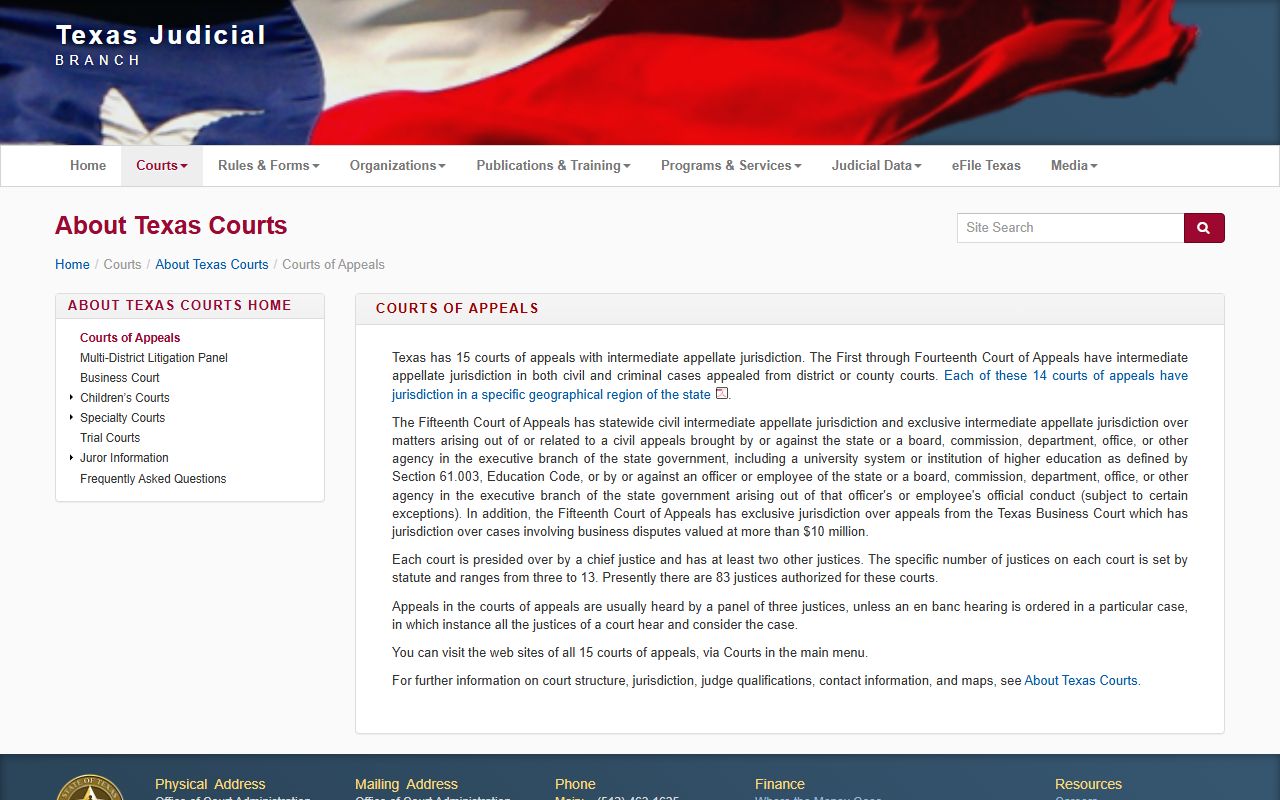
The two state high courts sit at the very top. The Texas Supreme Court is the final word on civil and juvenile matters, while the Court of Criminal Appeals is the final word on criminal cases. The Texas Courts of Appeals overview is shown below.
Common Questions About Hidalgo County Courts
A few questions about the court structure come up often. The short answers below clear them up.
How many district courts does Hidalgo County have?
The county has 13 numbered district courts, each with its own elected judge, all based at the courthouse in Edinburg. They handle felonies, larger civil suits, family cases, and juvenile matters. Alongside them sit county courts at law, justice courts, and a probate court. To search the files these courts produce, use the court records tool.
Which court hears my case?
It depends on the matter. A felony or a large civil suit goes to a district court. A misdemeanor or a smaller civil matter goes to a county court at law. A ticket or small claim goes to a justice court, and an estate goes to the probate court. The comparison chart above breaks down the levels.
Where do appeals from the district courts go?
Appeals go to the Thirteenth Court of Appeals, the intermediate appellate court for this region. From there, a final appeal can reach the Texas Supreme Court for civil matters or the Court of Criminal Appeals for criminal cases. The FAQ answers more questions about the courts.
Finding Hidalgo County District Court Records
District court files are kept by the District Clerk, and the public can search most of them for free online. The Records Inquiry portal lets you look up a case by number, party name, attorney, or citation, then read the register of actions. Online copies are unofficial, so a certified copy still comes from the clerk. For family and sensitive cases, some files may not appear online at all.
To search the case records directly, use the court records tool, and for the office that holds the files and sells certified copies, see the District Clerk page. Common questions are answered on the FAQ.