
How to Search for Hidalgo County Warrants
There is no one portal that lists every active warrant in the county. Warrant data is spread across justice, constable, jail, and court pages. So a warrant check usually means looking in more than one place. Start with the court systems you can search, then call the issuing court to confirm.
Here is the practical order to check for a Hidalgo County warrant.
- Search the criminal case records in the Records Inquiry portal for capias or warrant docket events.
- Search the jail records to see if the person is already in custody.
- If a JP or municipal court is involved, contact that court directly.
- Ask the issuing court about the warrant type, bond, and recall steps.
- Confirm any payment or court date before you rely on it.
For the case files themselves, use the Hidalgo County court records search.
Why Hidalgo County Has No Single Warrant Portal
Texas counties spread court power across many separately elected offices. Hidalgo County alone has nine justices of the peace, five constables, a sheriff, and more than a dozen district courts. Each issues or executes process on its own. That is why no single page lists every active warrant.
The closest public tools are the criminal case search and the jail roster. A warrant often surfaces in a case as a capias or a failure-to-appear event. Once an arrest happens, the booking shows in the jail records.
Justice Courts and Warrant Postcards
Justice of the peace courts issue search and arrest warrants, and they handle the Class C tickets that often turn into warrants. If you got a warrant postcard in the mail, it points back to a JP court. JP Precinct 5, Place 1 even tells residents with a pending ticket or a warrant postcard that they can pay online. Payments at some JP offices go through pay.hidalgocounty.us.
The county lists each JP court by precinct and place. The Hidalgo County Justice of the Peace page is shown below.
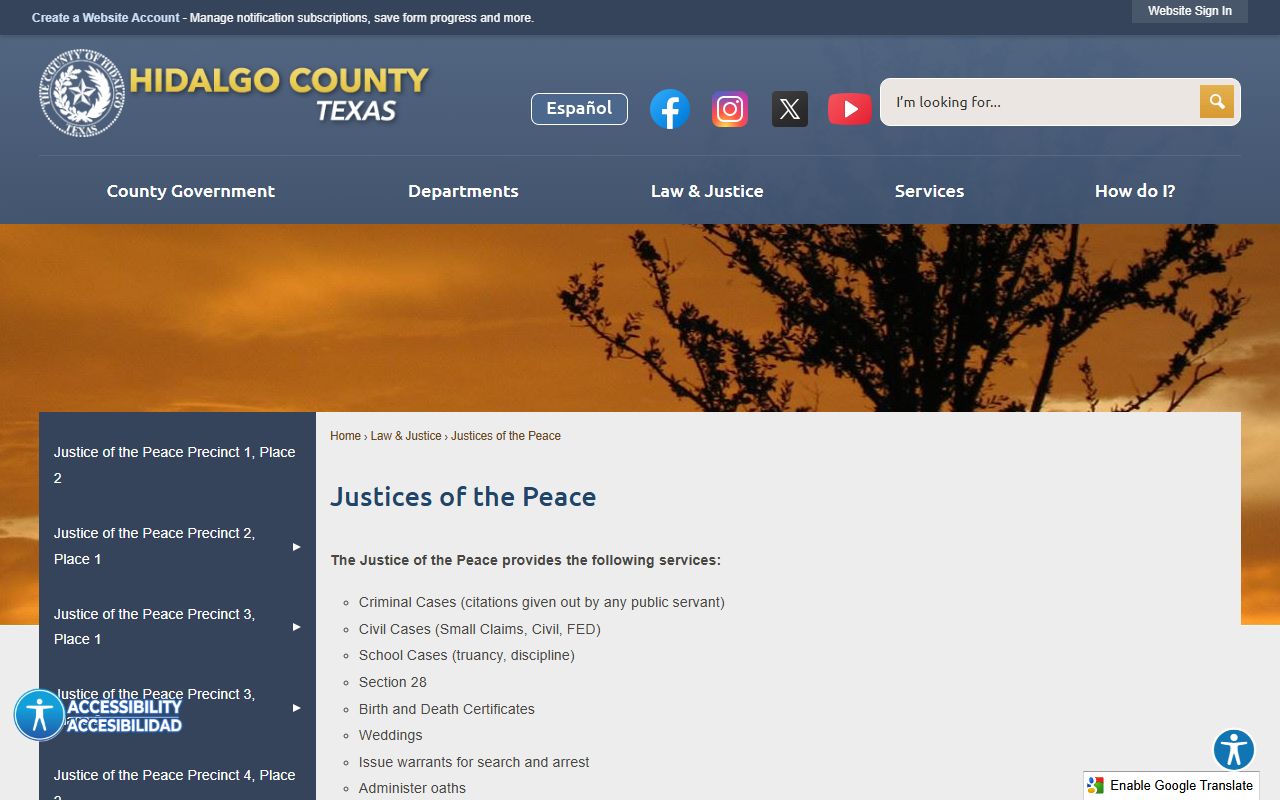
The JP map is geographic: Weslaco and the east in Precinct 1, Pharr and the south in Precinct 2, Mission and the west in Precinct 3, Edinburg and the north in Precinct 4, and the Delta area in Precinct 5.
Constables and Warrant Execution
Constables are peace officers with the same arrest power as the sheriff and city police. They also serve civil process for the courts. A constable can execute warrants, subpoenas, writs, citations, notices, and eviction actions across the county.
So while a JP court may issue a warrant, a constable or the sheriff often serves it. That split is one more reason a single county warrant list does not exist.
Types of Warrants in Hidalgo County
Warrants come in a few forms, and the type shapes how you resolve it. The terms below come up most often in Texas court files.
- Arrest warrant
- An order to take a named person into custody on a charge.
- Search warrant
- An order that lets officers search a place for evidence.
- Capias
- A Texas order to arrest a person, often after a missed step in a case.
- Capias pro fine
- A warrant tied to unpaid fines or an unsatisfied judgment.
A capias or capias pro fine may appear as an event in the court records search.
Jail Records After an Arrest
Once a warrant is served, the person is booked. At that point the arrest shows in the public jail records. You can confirm custody and bond status there. The jail search takes a name or a booking number.
For the full roster and bond details, see the Hidalgo County inmate records page. Recent bookings also appear on the arrest records page.
How to Resolve an Outstanding Warrant
Clearing a warrant the right way protects you from a surprise arrest. The path depends on the issuing court and the warrant type. The steps below work for most county matters.
- Identify the issuing court: JP, municipal, county court at law, or district court.
- Search the Records Inquiry portal by case, party, or citation if it is in county systems.
- Call the issuing court clerk before you appear, and ask about bond and recall.
- For a traffic or Class C matter, confirm whether you can pay online or must appear.
- If the warrant is for a jailable offense, talk to a lawyer before you surrender.
- After payment, bond, or a court order, confirm the warrant was recalled.
Important: Do not ignore a warrant postcard. Contact the issuing court to confirm the warrant type and your options before the matter grows.
Searching Related Court Cases for Warrant Events
The criminal case search is the most useful public tool for warrant clues. When a court issues a capias or notes a failure to appear, that event can show up in the case docket. So a search of the Records Inquiry portal by case number, party name, or citation may reveal a warrant tied to an open case. The case file will not always say the word warrant, but a capias event, a bond forfeiture, or a failure-to-appear entry points the same direction.
Run the search in the criminal lane first, since most arrest warrants attach to criminal matters. If you only have a ticket, search by citation number. Keep in mind that the portal shows unofficial copies and that not every case is online. For the full case behind a warrant event, request records from the District Clerk or check the court records search.
Paying or Contesting a JP Warrant or Ticket
Many county warrants grow out of unpaid traffic and Class C tickets in the justice courts. The county lets residents handle some of these online. JP offices direct people with a pending ticket or a warrant postcard to pay through pay.hidalgocounty.us, and some offices take money orders and credit or debit cards in person. One JP office set a 4 p.m. cutoff for same-day payments and posted lunch-hour availability.
Paying is not your only option. You can also ask the court for a hearing to contest the ticket, request a payment plan, or ask about defensive driving where it applies. If a warrant has already issued, contact the JP court before you pay to confirm the warrant type and whether payment alone will recall it. For the ticket side of these cases, see the traffic court records page.
Bond and Surrender Considerations
For a jailable offense, an arrest warrant is serious, and how you respond matters. A person who learns of an arrest warrant should think about counsel before walking into the jail. A lawyer can arrange a surrender, line up a bond, and limit the time spent in custody. Bond may be a cash bond, a surety bond posted through a bondsman, or a personal recognizance bond based on a promise to appear.
Once a person is booked, the arrest shows in the public jail records, and bond status appears there too. The Hidalgo County indigent defense office can review whether a person qualifies for a public defender on a serious charge. For custody and bond status after an arrest, use the inmate records search.
Federal Warrants and Out-of-County Holds
Some warrants in the county are not county warrants at all. Hidalgo County lies in the Southern District of Texas, with a McAllen Division, and federal warrants flow through that system rather than the JP and district courts. A federal warrant is served by federal agents or the U.S. Marshals, and a person taken on one is held in federal custody, not always the county jail. The county tools will not show a federal warrant.
Holds from other counties or states can also attach to a person in the Hidalgo County jail. That is why a release is sometimes delayed even after a local bond is posted. If you suspect a federal matter, the case docket would be on PACER, the national federal records system, rather than the county portal. When in doubt, ask the jail or the issuing agency which system holds the warrant.
Common Questions About Hidalgo County Warrants
Two questions come up most when people worry about a warrant. The short answers help you act with a clear head.
Can I check for a warrant online? Not through one county warrant list, because none exists. You can search criminal cases and the jail roster for clues, then call the issuing court. The arrest records page covers the jail search.
What if I just got a warrant postcard? Do not ignore it. The postcard ties to a JP or municipal court. Call that court to confirm the warrant type, the bond, and whether you can pay or must appear. More answers sit on the FAQ.
Confirming a Warrant Was Recalled
Paying a fine or posting bond does not always close the loop right away. Ask the court to confirm the warrant was recalled and that the clearance was sent on. Keep your receipt and any court order. A short follow-up call can save you from an arrest on a warrant that should already be cleared.
For DWI or other driving offenses that can carry warrants, see the traffic court records page. More answers sit on the FAQ.