
The Hidalgo County Probate Court
Hidalgo County has a statutory Probate Court, which is not the case in every Texas county. It is headed by elected Judge JoAnne Garcia and sits on the third floor of the main courthouse. Because it is a standing court, probate matters here get a dedicated bench rather than being folded into a general county court. That focus speeds up estate and guardianship work for county residents.
Hidalgo County Probate Court
Judge: JoAnne Garcia
100 N. Closner, 3rd Floor
Edinburg, TX 78539
(956) 318-2385
Mon-Fri 8:00 a.m. to 5:00 p.m.
The court also offers a Probate Virtual Courtroom and a Mental Health Virtual Courtroom for remote hearings when the judge allows.
What Hidalgo County Probate Records Cover
The Probate Court handles more than wills. Its official jurisdiction is broad. It probates the wills of people who have died, declares the heirs of those who die without a will, sets up guardianships for incapacitated adults and minors, and supervises court-ordered involuntary mental health commitments. It also hears lawsuits tied to estates of decedents or wards and actions by or against personal representatives.
Ancillary matters can reach into other areas of law. The court's jurisdiction can include product liability, fiduciary litigation, medical malpractice, and family law claims that connect to an estate or a ward. So probate records here range from a simple will to complex estate litigation. For estate-related family matters, the marriage and divorce records page is a useful companion.
How to Search Hidalgo County Probate Records
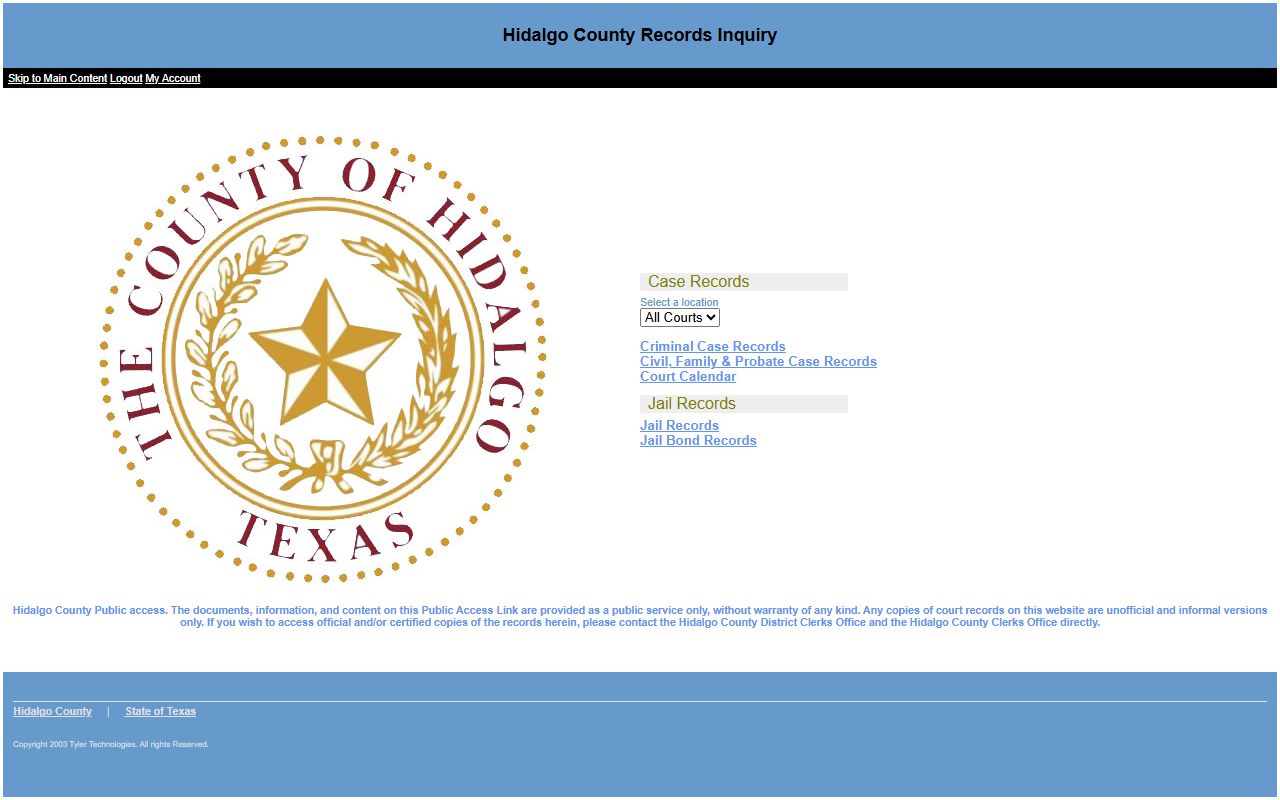
Probate cases share a search lane with civil and family cases. In the Records Inquiry portal, you open the Civil, Family and Probate Case Records search and look up a matter by case number, party or business name, attorney, case status, or filing date. The steps below walk through it.
- Open the civil, family, and probate search at pa.co.hidalgo.tx.us.
- Search by case number if you have it, or by party name if you do not.
- Add a date range or case status to narrow the results.
- Open the case to read the register of actions.
- Request a certified copy from the clerk if you need an official record.
The civil, family and probate search is shown below.
Probate Terms Defined
Probate has its own vocabulary, and the words shape what a record means. The short glossary below covers the terms you will meet most in Hidalgo County probate records.
- Testator
- A person who makes a will.
- Executor
- The person named in a will to carry it out.
- Intestate
- Dying without a valid will, so the court declares the heirs.
- Guardianship
- Court authority over a minor or an incapacitated adult.
- Conservatorship
- Court-supervised control of a person's care or estate.
- Heirship
- A court finding of who legally inherits when there is no will.
An executor named in a will and a court-appointed administrator do similar work, but the court appoints the administrator when there is no valid will.
Hidalgo County Probate Filing Fees
Probate filings run through the clerk, and copies carry set fees. Specific filing fees are set by statute and can vary by the type of case, so confirm the exact amount with the clerk before you file. The table below lists the common copy and certification fees you will meet for a Hidalgo County probate record.
| Item | Amount |
|---|---|
| Copies per page | $1.00 |
| Certification | $5.00 |
| Official records search fee | $5.00 |
| Probate filing fee | Set by statute; confirm with the clerk |
For the full fee schedules and copy methods, see the County Clerk and District Clerk pages.
How a Probate Case Moves Through the Court
A probate matter follows a set path, though the exact steps depend on the type. The outline below shows the common flow for an estate in Hidalgo County.
- Determine whether there is a will, an estate, an heirship, a guardianship, or a mental health matter.
- File in the Hidalgo County Probate Court if venue belongs here.
- Pay the filing fees through the clerk.
- Obtain hearing settings, notices, citations, and service as required.
- Attend the hearing in person or by virtual courtroom when allowed.
- Obtain the court's orders, such as admitting a will or naming an administrator.
Guardianship cases add steps like a physician's certificate, an attorney ad litem, a bond, and annual reporting.
Restricted Probate Records
Not all probate files are fully open. Guardianship cases that involve minors and incapacitated adults can carry access limits to protect vulnerable people. Mental health commitment records are largely confidential under health and court privacy law, even though the Probate Court supervises those commitments. So a search may show that a case exists without opening every document in it.
When a record is restricted, access usually requires a proper interest or a court order. Ask the clerk what is available and what a request needs. For the broader rules on confidential court records, see the court records page.
The Probate Virtual Courtroom
Hidalgo County's Probate Court has built remote access into its work. The court's page offers a Probate Virtual Courtroom and a separate Mental Health Virtual Courtroom, which let parties, attorneys, and witnesses appear without coming to the courthouse when the judge permits it. For estate and guardianship matters that may involve elderly or incapacitated people, remote appearance can be a real help, since travel and health can be barriers.
The virtual option does not change the underlying record. Hearings held by video still produce orders, settings, and filings that show in the case file, and certified copies still come from the clerk. If you have a hearing set, confirm with the court whether it will be in person or virtual, and ask for the link or instructions ahead of time. The same case appears in the online register of actions whether the hearing was held in the courtroom or by video.
Common Questions About Hidalgo County Probate Records
Probate raises a predictable set of questions, especially for families handling an estate for the first time. The short answers below cover the basics.
Where is probate handled in Hidalgo County? In the statutory Probate Court on the third floor of the courthouse at 100 N. Closner, Edinburg, with Judge JoAnne Garcia presiding. The court handles wills, heirship, guardianship, and mental health matters.
Can I search probate cases online? Yes. Probate shares the civil and family search lane in the Records Inquiry portal. You can search by case number, party name, or attorney. Online copies are unofficial.
Why is a guardianship case hard to view? Cases involving minors, incapacitated adults, and mental health carry tighter access rules to protect vulnerable people. Ask the clerk what is available. The court records page covers restricted records, and more answers sit on the FAQ.
Getting Help with a Hidalgo County Probate Case
Probate can be straightforward or complex, and knowing which one you face helps you plan. A small estate with a clear will and few assets may move quickly. An estate with disputes, debts, or a guardianship can take months and several hearings. Guardianship cases in particular carry extra duties, including a physician's certificate, an attorney ad litem appointed to protect the ward, a bond, and annual reporting to the court. Those steps exist to safeguard people who cannot speak for themselves.
Self-represented filers can use the Texas State Law Library and TexasLawHelp for procedural guidance, though probate and guardianship often warrant a lawyer because of the bonds, accountings, and fiduciary duties involved. The clerk can tell you what a filing needs but cannot give legal advice. When an estate involves real property, the deed and lien records held by the County Clerk also come into play. For those property records, see the County Clerk page, and for the underlying court files, the court records search.
Certified Probate Copies
Banks, title companies, and other courts often want a certified copy of a probate order, not a printout from the portal. The online record is unofficial. For letters testamentary, letters of administration, or an order admitting a will, request a certified copy from the clerk. Bring the case number to speed things up.
A certified copy carries the clerk's seal and is accepted where an official record is required, while a plain copy is fine for personal reference. Bring or include the case number, the names of the parties, and the exact document you need, since a vague request slows the search. If a probate case is old, the file may need to be pulled from storage, which can add time. For more on the request process and common questions, see the FAQ.