
How to Search Hidalgo County Court Records
Most Hidalgo County court records are searched through one free tool. It is the Hidalgo County Records Inquiry portal, an older Tyler/Odyssey public access system at pa.co.hidalgo.tx.us. The launch page splits access into Case Records and Jail Records. Under Case Records you pick Criminal Case Records, Civil, Family and Probate Case Records, or Court Calendar. Each lane uses the same search form style.
Before you start, gather what you know. A case number is the fastest way in. If you do not have one, a full name and date of birth will do. Have a citation number ready for traffic or Class C matters. The portal is free, but the copies it shows are unofficial.
The Hidalgo County District Clerk's office runs the public records inquiry website, which launched in 2013. Here is the basic path to find a case.
- Open the Records Inquiry menu at pa.co.hidalgo.tx.us and pick the right lane for your case type.
- Choose how to search: by case number, party or defendant name, attorney, or citation.
- Enter the case number if you have it, or a last name and first name if you do not.
- Narrow the list with date of birth, case status, or a filing date range.
- Open the case to read the register of actions, then request a certified copy from the clerk if you need one.
The official Records Inquiry launch page lays out each search lane in one place. The Hidalgo County Records Inquiry portal is shown below.
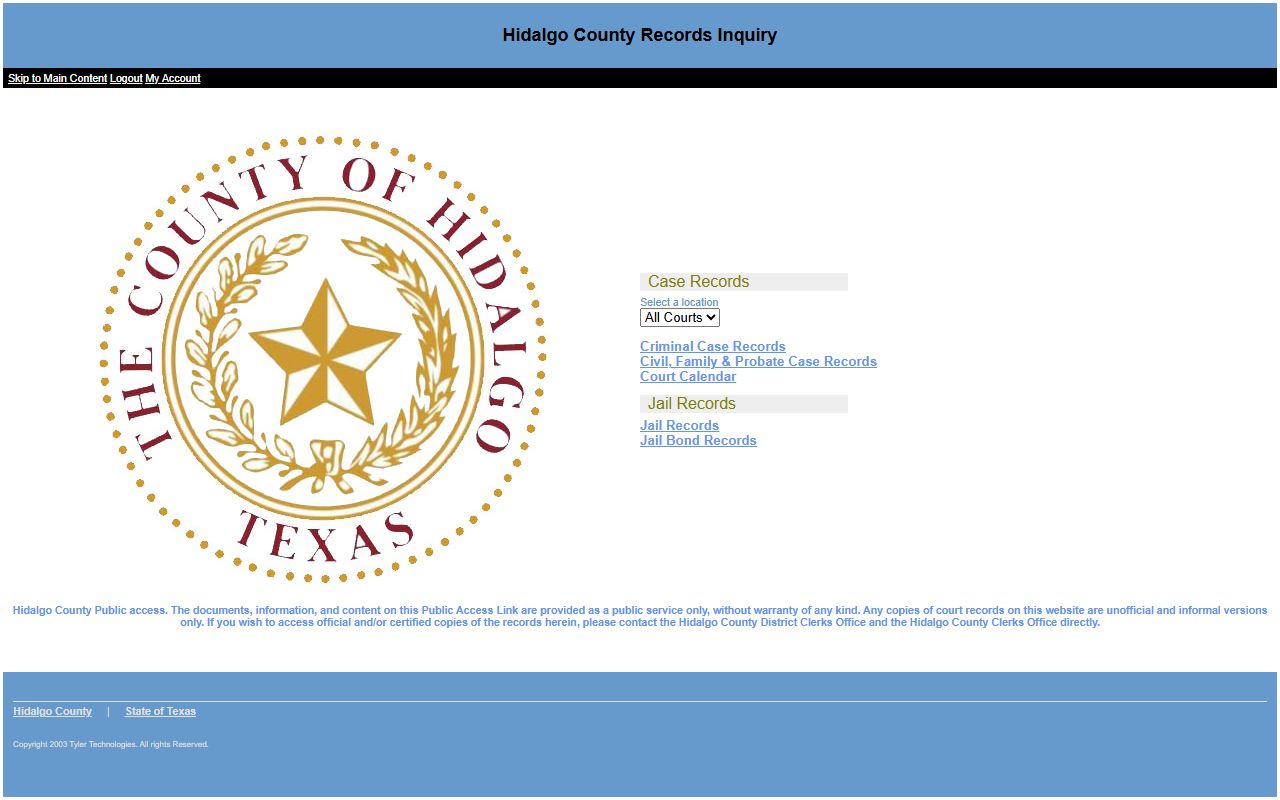
From this menu you can reach criminal, civil, family, probate, calendar, and jail searches. The same portal feeds the Hidalgo County court records and court dockets pages.
Hidalgo County Court Records Search Fields
The criminal case search form gives you the most control. You first pick a Search By mode, then fill the fields that mode needs. Name searches allow Soundex and exact-name options. Wildcards have minimum character rules. The table below lists the main fields on the Hidalgo County court records search form.
| Field Label | Type | Required | Notes / Format |
|---|---|---|---|
| Search By | Dropdown | Yes | Case, Defendant, Citation, or Attorney. |
| Case Number | Text | In case mode | Max 30 characters; wildcard needs 4 non-dash characters. |
| Last Name | Text | In name mode | Max 80; wildcard needs at least 3 characters. |
| First Name | Text | In name mode | Max 40; wildcard needs at least 1 character. |
| Date of Birth | Date | No | Narrows a name search; format like 11/12/1955. |
| Case Status | Radio | No | All, Open, or Closed. |
| Date Filed Range | Date | No | On or after and on or before fields. |
The civil, family, and probate search uses the same framework but labels the party field as Party or Defendant Name. Full field details sit on the court records page.
The Hidalgo County Judicial System
Texas builds its trial courts in layers, and the levels overlap. At the base sit municipal and justice of the peace courts. Above them are the constitutional county court and the county courts at law. District courts are the general trial courts for the state. Hidalgo County has 13 district courts, multiple county courts at law, a probate court, and nine justice of the peace courts spread across five precincts.
District courts hear felony crimes, larger civil suits, family cases, and juvenile matters. County courts at law take misdemeanors, smaller civil suits, and family cases. Justice courts handle small claims, evictions, Class C tickets, and warrants. Appeals from the district courts go to the Texas courts of appeals; Hidalgo County sits in the Thirteenth Court of Appeals district.
Case flow: Justice Court › County Court at Law › District Court › Court of Appeals
| Court | Jurisdiction | Case Types |
|---|---|---|
| District Courts | General trial, felony level | Felonies, large civil suits, divorce, juvenile |
| County Courts at Law | Statutory county level | Misdemeanors, civil, family, appeals from lower courts |
| Probate Court | Estates and guardianship | Wills, heirship, guardianship, mental health |
| Justice of the Peace | Limited, fine-only | Small claims, eviction, Class C, truancy, warrants |
The county lists every district court and its judge online. The Hidalgo County District Courts page is shown below.
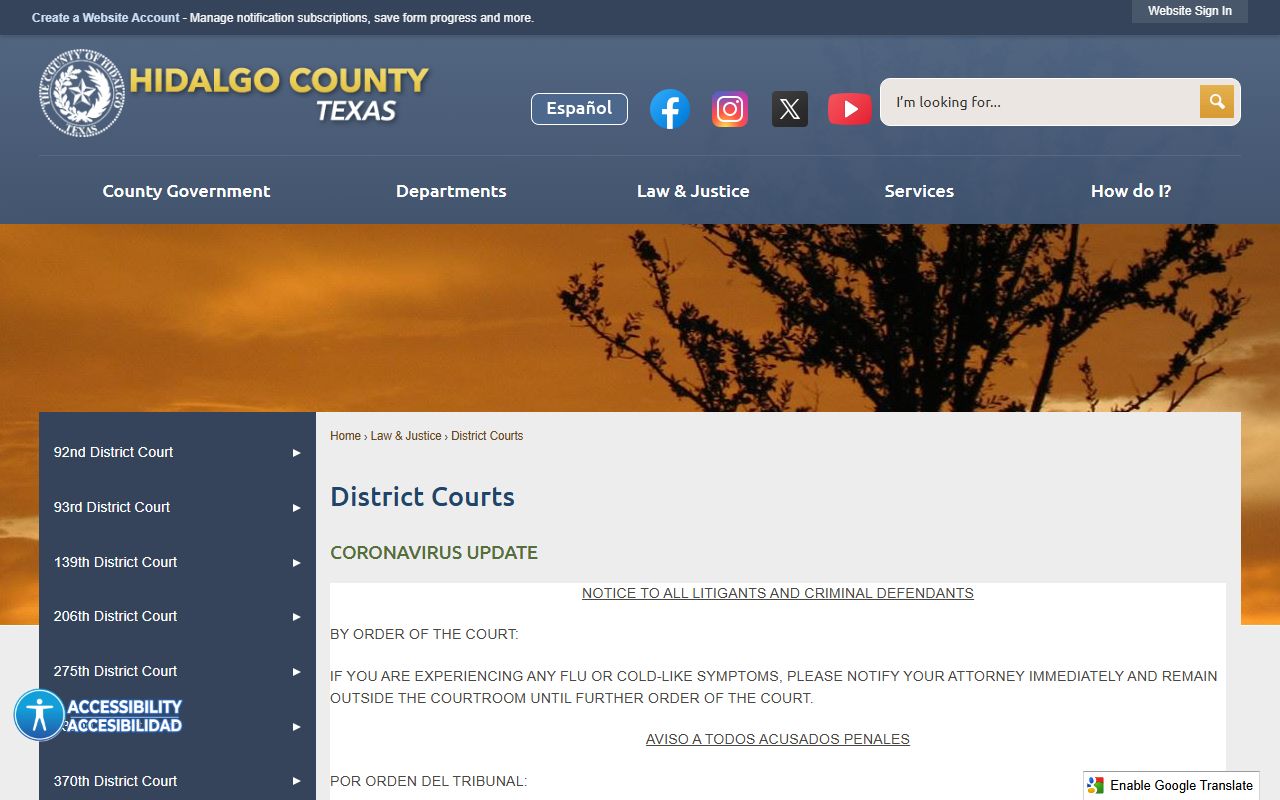
For a court-by-court breakdown with judges and addresses, see the Hidalgo County District Court page.
District Court vs County Court vs Justice Court
Picking the right court matters because each one keeps its own records. The chart below shows what separates the three main trial levels in Hidalgo County. Use it to decide where a case lives before you search.
| Feature | District Court | County Court at Law | Justice Court |
|---|---|---|---|
| Crime level | Felonies | Misdemeanors | Class C, fine-only |
| Civil reach | Larger claims | Mid-range claims | Small claims, eviction |
| Family cases | Divorce, custody | Some family matters | None |
| Records clerk | District Clerk | County Clerk | JP court clerk |
The split clerk system trips up many searchers. District court files go to the District Clerk. County court and county court at law files go to the County Clerk.
Hidalgo County Courthouse and Offices
Most courts and the District Clerk sit in the main courthouse in downtown Edinburg. The Probate Court is on the third floor. The sheriff and the jail are at a separate site east of town. The open records division works from a county office on McColl Road. The cards below give the addresses you will use most for Hidalgo County court records.
Hidalgo County Sheriff's Office
711 El Cibolo Rd.
Edinburg, TX 78541
(956) 383-8114
Open Records Division
505 S. McColl Rd., Suite J
Edinburg, TX 78539
(956) 292-7655
The county website is the gateway to every department. The Hidalgo County homepage appears below.
Types of Court Records Available in Hidalgo County
Hidalgo County court records cover a broad set of case types. Which court made the record tells you where to find it. District courts produce felony and large civil files. County courts at law hold misdemeanors and many family matters. The probate court keeps estate and guardianship files. Justice courts hold small claims, evictions, and traffic citations.
Below are the main record types and what each one holds.
- Criminal records - felony cases in district court and misdemeanors in county court; see arrest records.
- Civil records - contract disputes, injury suits, and property claims.
- Family and divorce records - divorce, custody, and support; many are limited online. See marriage and divorce records.
- Probate records - wills, estates, and guardianship; see probate records.
- Traffic records - citations and fine-only matters; see traffic court records.
What Hidalgo County Court Records Show
A case file in the portal shows a register of actions. That is a running summary of the style of the case, the parties, the events and orders, and the financial history. Older District Clerk bulletins describe these same fields. Not every field is public; sensitive identifiers are redacted or held back.
| Field | What It Shows |
|---|---|
| Case Number | The cause number that identifies the file; up to 30 characters. |
| Filing Date | The date the case was opened with the clerk. |
| Parties | Plaintiff or state, defendant or respondent, and attorneys. |
| Charges / Cause | The charge in a criminal case or the claim in a civil case. |
| Disposition | The outcome, such as a plea, judgment, or dismissal. |
| Financial | Court costs, fines, bonds, and fees tied to the case. |
Note: Cases with Social Security numbers, driver license numbers, or child information may not appear online and must be requested from the clerk.
Public Access Laws for Hidalgo County Court Records
Texas keeps two tracks for public records. County administrative files fall under the Texas Public Information Act, Government Code Chapter 552. Court case files are different. The Texas State Law Library guide explains that court records are governed by common law, statutes, and court rules, and are not subject to the Public Information Act or federal FOIA. Hidalgo County's open records division processes department requests but warns that each elected official is the custodian of their own records.
A few statutes shape what you can and cannot see in Hidalgo County court records. The callout below puts the key ones in plain words.
Key Statutes:
Texas Government Code § 552.021 - Public information must be made available to anyone who asks, with no reason required.
Texas Government Code § 552.101 - Information made confidential by other law, such as juvenile or health records, can be withheld.
Texas Code of Criminal Procedure Chapter 55 - Sets out when a criminal record can be expunged and erased from public view.
More on filing a request sits on the public records page. The Texas State Law Library court records guide is a good plain-language source.
Records That Are Restricted or Confidential
Not all court files are open. Juvenile records are limited by state law, and requests go to the custodian at the juvenile justice center. Many family cases, divorce among them, may stay offline because they hold sensitive data or child information. Mental health commitment files supervised by the probate court are largely closed. Adoption records are sealed unless a court orders otherwise.
To view a sealed record, you usually need a court order. Texas Rule of Civil Procedure 76a sets the standard for sealing civil court records, which start out presumed open. Expunged criminal records are erased under Chapter 55, and nondisclosure orders under Government Code Chapter 411 limit who can see certain criminal history. A petition is filed in the court that handled the case.
Specialty Court Functions in Hidalgo County
Hidalgo County runs several specialized court functions. The probate court supervises court-ordered involuntary mental health commitments and offers a Mental Health Virtual Courtroom. It also handles guardianships for minors and incapacitated adults, which makes it the center for protective proceedings. The Judge Mario E. Ramirez Jr. Juvenile Justice Center runs juvenile detention and probation under separate rules.
The county also funds a Public Defender's Office for people who cannot afford a lawyer. Its mission is to give strong legal help to indigent defendants and to protect their constitutional rights. The office represents a person from the time charges are filed through the final appeal.
Hidalgo County Sheriff and Jail
The Hidalgo County Sheriff's Office is led by Sheriff J.E. "Eddie" Guerra. The office sits at 711 El Cibolo Rd. in Edinburg, and the adult detention facility is nearby. The sheriff runs the jail, handles inmate search, and supports the courts. To find someone in custody, use the jail records search in the same Records Inquiry portal.
The sheriff's official page lists contact details and the office mission. The Hidalgo County Sheriff page is shown below.
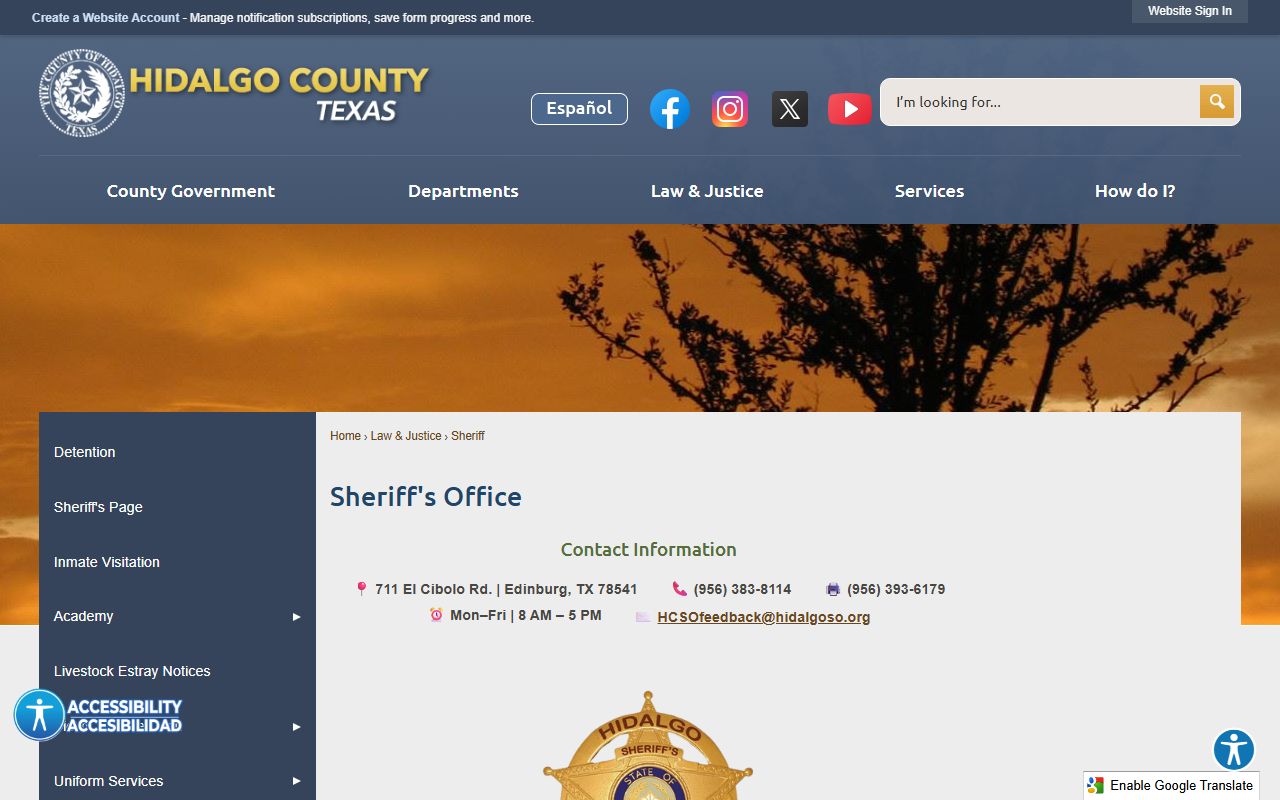
For the roster, see Hidalgo County inmate records. To check active warrants, see warrant records. For releases, see released inmates and jail population data.
Marriage, Divorce, and Probate Records
The County Clerk issues marriage licenses and keeps county records. The District Clerk holds divorce and other family case files filed in district court. The probate court handles wills, estates, and guardianships. A few terms come up often in these files.
- Testator
- A person who makes a will.
- Executor
- The person named to carry out the will.
- Intestate
- Dying without a valid will, so the court names the heirs.
- Guardian
- A person given court authority over a minor or incapacitated adult.
For details, see marriage and divorce records and probate records. License questions go to the County Clerk.
Hidalgo County Court Records Fees
Online searches are free. Copies and certifications cost money, and the price depends on the clerk and the format. The District Clerk charges by electronic page. The County Clerk has a separate fee schedule for recordings, searches, and vital records. The table below lists common Hidalgo County court records fees.
| Item | Amount |
|---|---|
| Electronic copy (District Clerk), up to 10 pages | $1.00 |
| Each page over 10 (District Clerk) | $0.10 |
| County Clerk copies per page | $1.00 |
| County Clerk certification | $5.00 |
| Official records search fee | $5.00 |
Civil and family suits filed with the District Clerk carry a base filing fee of $350. Full fee lists sit on the District Clerk and County Clerk pages.
How to Interpret Hidalgo County Court Records
Court files use shorthand. A few terms unlock most records. A cause number is the Texas name for a case number. A disposition is the outcome of a charge or claim. A capias is a Texas warrant to take a person into custody, and a capias pro fine is tied to unpaid fines.
Watch the gap between a charge and a conviction. An arrest or a filed charge is not proof of guilt. The disposition line tells you what really happened, such as a guilty plea, a dismissal, or a not-guilty finding. A case "dismissed with prejudice" cannot be refiled; one dismissed "without prejudice" can. When a record is unclear, call the clerk that holds the file.
Accuracy and Record Limitations
Online court data can lag behind the paper file. New filings take time to post, and disposed cases that were never imaged may need to be pulled from storage. The portal itself warns that its copies are unofficial and informal.
Note: Always confirm a case detail with the District Clerk or County Clerk before you rely on it for any legal, financial, or personal decision.
History of Hidalgo County Courts
The office of County Clerk has existed in Texas since 1836, and Hidalgo County stresses that its clerk preserves county history. The county now has 47 elected officials and about 3,300 employees. Court records are split among many of them, each with separate custody.
Technology changed how the public reaches these records. The county bought its Odyssey case system in 2008. The civil access link launched in April 2012, and the full Public Records Inquiry website went live in 2013 at pa.co.hidalgo.tx.us. That shift moved Hidalgo County court records from paper-only to free online search.
Frequently Asked Questions
How do I search Hidalgo County court records online?
Use the free Hidalgo County Records Inquiry portal at pa.co.hidalgo.tx.us. Pick Criminal Case Records, Civil, Family and Probate Case Records, or Court Calendar. You can search by case number, name, attorney, or citation. Online copies are unofficial. For certified copies, contact the District Clerk or County Clerk.
Why can't I find a divorce case online?
The District Clerk warns that not all cases are online. Many family cases, including divorces, hold sensitive data, child information, or personal identifiers like Social Security numbers. Those files may be left out of the public portal. You can ask the District Clerk about access. More sits on the marriage and divorce records page.
Are the online copies official?
No. The portal disclaimer says its records are provided as a public service without warranty and are unofficial. For an official or certified copy you must contact the clerk that holds the file. See the court records page for how to request copies.
More answers sit on the Hidalgo County Court Records FAQ page.